

Asking a question like "Are 2 Stroke Boat Motors still in production?" clearly indicates a novice in marine propulsion. Experienced boat owners know that two-stroke outboard motors are indeed still in production and remain important in certain specific areas.
What Is A Two-Stroke Boat Motor?
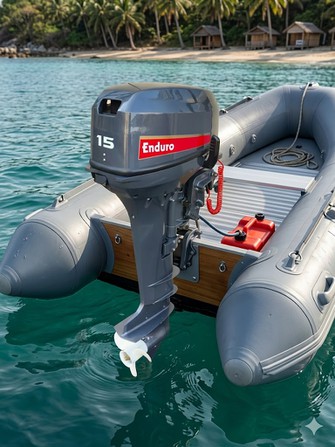
An outboard motor engine is a vessel's propulsion system and is an independent unit. It is typically mounted at the stern, and its main components include the engine, gearbox, and propeller (jet drive). Two-stroke boat motors are one type of marine outboard engine; another type is called a four-stroke outboard engine. A two-stroke outboard engine completes intake, compression, power stroke, and exhaust within two strokes of the crankshaft's rotation.
Unique Advantages of Two-Stroke Outboard Engines
Unlike four-stroke outboard motors, two-stroke outboard engines have a simpler structure, stronger explosive power, lighter weight, and lower maintenance requirements. The advantages of two-stroke outboard motors are that they are not demanding in terms of environment or oil type, and they start immediately. They also have strong low-speed torque and rapid thrust. Two-stroke marine motors have become a favorite among many fishermen due to their practicality, ease of maintenance, and low maintenance threshold.
Why Do Some People Think That 2 Stroke Outboard Motors Are No Longer In Production?
Since the advent of 4 stroke outboard motors, driven by environmental regulations, their market share in Europe, America, and Australia has increased, while the share of two-stroke outboard motors has decreased. However, this doesn't mean that two-stroke marine motors have disappeared or ceased production.
Due to stricter environmental requirements, especially in developed countries where emission standards for engines have become more stringent, two-stroke marine engines, which use a mixture of fuel and oil for combustion, produce more unburned hydrocarbons in their exhaust, thus facing more restrictions. Meanwhile, four-stroke outboard motors have higher combustion efficiency, lower noise, and are more environmentally compliant. Under these policy requirements, many boat owners have had to abandon two-stroke outboard motors and opt for four-stroke ones.
Two-Stroke Outboard Boat Motors Are Still In Production
Even so, two-stroke outboard boat motors still exist and are still being produced. Not all countries in the world are developed. In markets like Africa, South America, and Southeast Asia, 2-stroke marine motors remain the most popular marine propulsion system. In these countries and regions, maintenance conditions are limited, fuel requirements are lower, and boat owners prioritize cost and durability. 2 Stroke marine engines, with their inherent advantages, remain the mainstay of marine propulsion.
Furthermore, in specific applications such as rescue operations, law enforcement operations, and shallow-water operations, two cycle outboard motors remain irreplaceable. These scenarios prioritize instantaneous acceleration, lightweight design, and ease of maintenance. For example, rescue boats, high-speed law enforcement vessels, and shallow-water workboats are often equipped with two-cycle outboard engines of varying horsepower.
It is foreseeable that two-stroke outboard motors will not disappear or withdraw from the market; instead, they will become more specialized. Although their global market share may decline, they will remain stable in their preferred markets and regions. Experienced captains, in particular, tend to favor the stable and controllable two-stroke outboard motor. Their reasons for insisting on two-stroke outboard motors are:
• No complex valve structure;
• No sophisticated lubrication system;
• Not picky about oil types, highly adaptable to various environments;
Two-Stroke Outboard Boat Motors Vs. Four-stroke Outboard Boat Motors
Should I choose a two-stroke or a four-stroke outboard boat motor? There isn't a single answer. The choice depends on your usage scenario and the policy requirements of your country.
| Two-Stroke Outboard Motors Are More Suitable For | Four-Stroke Outboard Motors Are More Suitable For |
| Scenarios requiring frequent engine disassembly and assembly | Areas with strict emission restrictions and high environmental requirements |
| Low maintenance threshold, less reliance on complex repairs | Areas with noise control requirements |
| Prioritizing power output | Lower long-term fuel consumption |
| Frequently operating in remote waters | High comfort requirements |
Conclusion
The charm of sailing lies in active exploration, and choosing a marine propulsion system is also a process of examining your usage scenario. Choosing different power sources means choosing different ways to sail the seas. Are you still looking for the right power source for your boat? For more information on outboard motors, please contact KLS Supplier:
• +8615094051894
• Room 1705, Yihe Blue Diamond, No. 154, West Section of Second Ring South Road, Yanta District, Xi'an City
References
Wikipedia Outboard Motor.
2 Stroke Vs 4 Stroke Outboard Motor Boat Engine Comparison.