

Many boat owners, when selecting an outboard motor, focus solely on horsepower while overlooking the critical choice of shaft length. Take, for instance, a 40 HP Two Stroke Outboard Motor-a favorite among small to medium-sized fishing boats and speedboats. Deciding whether to opt for a long-shaft outboard or a short-shaft outboard is significant. Shaft length can make or break a voyage; if the length is unsuitable, even with a high-performance outboard motor, it will fail to deliver its intended power output. Worse yet, it could compromise navigational safety and actually prove counterproductive. Today, let's take a deep dive into this topic to provide a comprehensive, educational guide for boat owners preparing to equip their vessels with an outboard engine.
What Exactly Is Outboard Shaft Length?
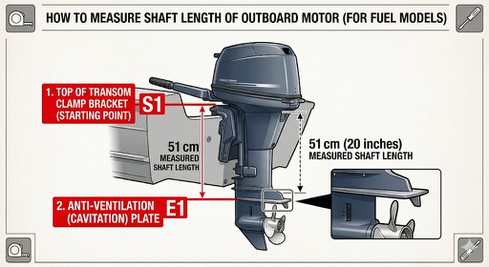
First, let's clarify what "outboard motor shaft length" actually refers to. Shaft length is defined as the vertical distance from the engine's mounting bracket to the center axis of the propeller. It is determined solely by the distance between the mounting point and the propeller's hub. A quick clarification: the total vertical distance from the very top of the engine cowling to the very bottom of the propeller is *not* the shaft length. This overall dimension exceeds the actual shaft length and has no practical significance when matching a motor to a boat.
Why Is Choosing The Right Shaft Length So Important?
Some boat owners might harbor this question: "My 40hp two-stroke outboard engine generates so much thrust-what difference does it make if the shaft is a little longer or shorter? Could it really affect my boat's forward motion?" The answer is a resounding yes. Shaft length impacts not only the boat's forward movement and propulsion but also its operational efficiency and navigational safety; selecting the appropriate shaft length is absolutely crucial.
If the shaft length is incorrect, it creates a mismatch with the boat's transom (stern plate) height, severely compromising the outboard's performance. If the shaft is too short, the propeller sits too high-too close to the water's surface. This makes the propeller prone to "ventilating" (spinning in air), resulting in unstable power delivery and hindering the boat's acceleration. Conversely, if the shaft is too long, the propeller sits too low, increasing underwater drag, boosting fuel consumption, and reducing boat speed. Furthermore, the boat owner will notice a distinct lack of responsiveness in the steering-the vessel will feel sluggish, and the bow will tend to drift off course, becoming difficult to correct.
How Do You Match The Optimal Outboard Shaft Length To Your Boat?
To select the outboard boat motor with the optimal shaft length for your boat, follow these three steps:
1. Measure The Transom Height:
Locate the exact center of the boat's stern-the designated mounting position for the marine motor. Using a tape measure, measure vertically from the very top edge of the transom down to the lowest point of the boat's hull. This vertical distance represents the transom height. Note: It is crucial to measure vertically, rather than following the slope of the transom.
2. Measure The Outboard Motor's Shaft Length:
Using a 40-horsepower, two-stroke outboard motor as an example, the standardized measurement procedure is as follows:
Identify the boat motor's mounting bracket (clamp) to serve as the starting point for the measurement. Measure vertically downward from the top edge of the mounting bracket to the anti-cavitation plate. This vertical distance constitutes the outboard engine's shaft length. In most cases, the anti-cavitation plate is situated at the same horizontal level as the center axis of the propeller. The anti-cavitation plate is a horizontal metal fin located just above the propeller; its function is to prevent air from entering the propeller area, thereby ensuring optimal propulsion efficiency.
Outboard motor boat engines are categorized into the following three types based on their shaft length:
• Short Shaft Outboard Motor;
• Long Shaft Outboard Motor;
• Extra-Long Shaft Outboard Motor;
3. Match The Shaft Length To The Transom Height:
• If the transom height is between 38 cm and 45 cm, select a short tail outboard motor.
• If the transom height is between 50 cm and 57 cm, select a long tail outboard motor.
• If the transom height exceeds 63 cm, select an extra-long tail outboard motor.
Outboard motors with different shaft lengths are designed to fit transoms of varying heights. As long as the shaft length is correctly matched to the transom height, the marine engine will deliver its maximum propulsion efficiency.
4. Installation And Verification: Use The Anti-Cavitation Plate To Assess Fit
Once the outboard motor has been installed, you can verify whether the shaft length is appropriate by observing the position of the anti-cavitation plate. The ideal scenario is for the anti-cavitation plate to be positioned at the same horizontal level as the bottom of the boat's hull. It is also acceptable if the anti-cavitation plate sits 1 cm or 2 cm lower than the bottom of the hull.
Two scenarios indicate an improper fit:
• If the anti-cavitation plate sits significantly higher than the bottom of the hull, it indicates that the shaft length is too short.
• If the anti-cavitation plate sits significantly lower than the bottom of the hull, it indicates that the shaft length is too long.
Conclusion
While shaft length may appear to be merely a dimensional parameter, it directly impacts propulsion efficiency, navigational stability, and fuel economy. It serves as a crucial foundation for ensuring a vessel's performance and safe navigation, playing a paramount role. Before making a purchase, please measure your boat's transom height using the method described above to select the appropriate outboard motor-either a short-shaft or a long-shaft model-for your vessel. For further information about the 40 HP Two Stroke Outboard Motor, please get in touch with KLS Supplier:
• +8615094051894
• Room 1705, Yihe Blue Diamond, No. 154, West Section of Second Ring South Road, Yanta District, Xi'an City
References
Wikipedia Outboard Motor.
Does My Boat Need A Long Shaft Outboard Motor Or Short Shaft Outboard Motor?