

Many novice boat owners find it hard to figure out how to install Outboard Motors. It may look hard, but it's really easy if you do it the right way. This useful guide goes through the whole installation process step by step, so that every boat owner can feel sure about putting in their outboard engine.
Preparations Before Installing Outboard Motors: Get Ready
Get ready: "A workman must first sharpen his tools if he is to do his work well," as the proverb goes. Before we can install, we need to get ready the following tools: a measuring tape, a level, a set of wrenches, a set of socket wrenches, marine sealant, and, if needed, lifting equipment. We also need to make sure that the boat is tied up on secure ground, that the fuel system is disconnected, that the battery is detached, and that the engine is supported when we get these tools ready.
At the same time, we need to look at the sternplate's height and strength. The sternplate needs to be strong and the right size. To find the height of the sternplate, measure from the top of the sternplate down to the bottom of the hull. The right height for the sternplate is important since it affects the length of the wheelbase. If the height of the sternplate is 38 cm, choose a short shaft. If the height is 51 cm, choose a long shaft. If the height is 63 cm, choose an extra-long shaft.
Putting In The Outboard Motor
Next, we'll start putting in the outboard motor. Carefully raise it up and put it in the middle of the sternplate, making sure it's properly centred, flush against the sternplate, and straight up and down.
• Choose the height for the first installation: The Anti-Ventilation Plate should be level with the bottom of the hull or 1–2 cm higher than the bottom of the hull. A precise initial installation height makes sure that water flows well, lowers water resistance, and improves performance.
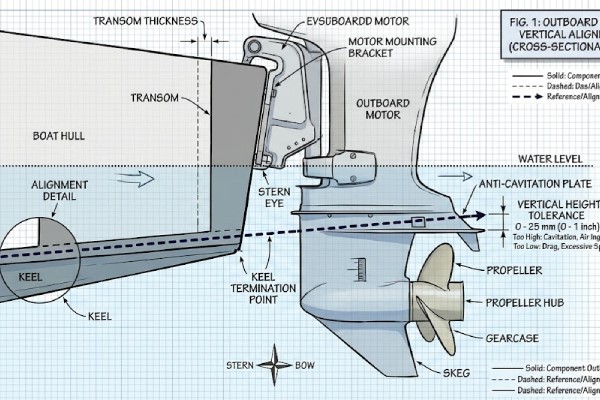
• Clamp and hold in place for a short time: Most boat motors come with mounting clamps. Make sure the clips are evenly tight on both sides by hand, and then verify the alignment again. Important: Don't use clips to hold anything in place for a long time.
• Drilling and sealing: Drilling is always scary, whether it's on a boat or anywhere else. Before you drill, make sure you measure three times. Mark the places where you need to drill by using the holes in the mounting bracket as a guide. Drill with the bit straight up and down. After you drill, don't forget to put a lot of marine sealant around the bolts and in the holes you drilled. The sealer is used to keep water from seeping in and to keep the stern plate from becoming wet and decaying.
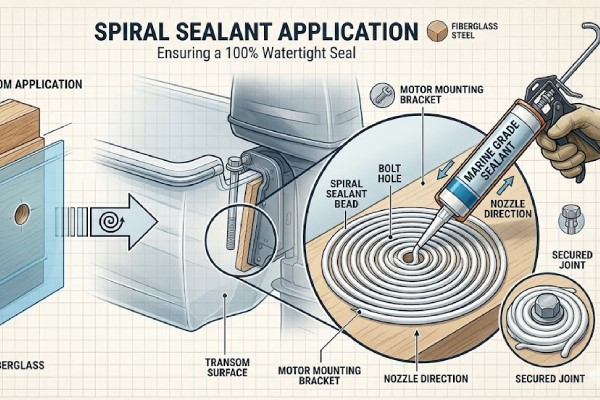
• Put in and tighten the bolts: Use strong stainless steel bolts and tighten them in the order of "washer-stern plate-washer-nut." Be careful with the force; tighten it evenly and don't use too much effort, which could bend the stern plate. Also, make sure it won't come free when it vibrates. It's fine as long as the engine is properly attached.
• Connect the steering system: If you have rudder-type steering, you don't need to do anything further to install it. If you have remote steering, you need to connect the steering wire to the engine so that it can steer smoothly to the left and right.
• Set up the gasoline system: Attach the fuel line to the engine, make sure the fuel tank is tight, and look for leaks. Always use the right connectors for marine fuel.
• Connect the electrical system: If the outboard motor boat engine has an electric starter, make sure you connect the battery cable, check the positive and negative terminals, and make sure the wires are secure.
• Check the tilt and adjustment functions: Make sure the engine can tilt up and down smoothly and stay in place.
• Do pre-start checks: Make sure the bolts are snug, the fuel lines are connected, and the coolant inlets are clear before starting the outboard motor.
• Sea trials: Don't just rely on land testing. During sea testing, make sure that the steering is sensitive, the acceleration is smooth, the cooling system's water flow is normal, and there is no strange vibration.
Things you should not do when installing a marine motor
①Installing too high or too low will produce cavitation or drag.
②Water will get in and harm the stern plate if the bolt holes are not sealed.
③Steering issues will happen if everything isn't lined up right.
④Using only clamps to hold things in place is not safe for long-term use.
Conclusion
It's very important to install outboard motors correctly. Boat owners will see a big difference in how smoothly their boats run, how much fuel they need, how fast they go, and how well they handle. Please get in touch with KLS for more information about 15 HP 2 Stroke Outboard Motor:
• +8615094051894
• Room 1705, Yihe Blue Diamond, No. 154, West Section of Second Ring South Road, Yanta District, Xi'an City
FAQ
Q1: Can I do it myself?
A1: You can put in outboard motors that are 15 hp or less. One person can't put in an outboard motor with a lot of power.
Q2: Should I drill holes in the sternplate?
A2: Drilling is important for permanent installations. Just using clamps isn't enough to make sure the installation is safe.
Q3: Why put on such a thick coat of sealant?
A3: The core of the sternplate is usually made of wood or a composite material. If water gets in via the bolt holes, it will rot, making the whole sternplate useless and costing a lot of money to fix.
Q4: Should you inspect the bolts on a regular basis?
A4: Yes! The bolts may come free a little bit because of vibration during the first 20 hours of sailing after installation. After the first trip and before the start of each season, it is best to verify with a wrench.
Q5: How tight do the bolts need to be?
A5: Make sure it's tight, but don't overdo it or the stern plate could break. It is best to use a torque wrench.
References
Wikipedia Outboard Motor