

When we begin selecting an Enduro Outboard Motor for our boat, we commonly hear the terms "long shaft outboard" and "short shaft outboard." Of course, in some regions, one might also occasionally hear them referred to as "long tail outboard motors" and "short tail outboard motors."
Understanding What "Tail Length" Means
"Tail length" actually refers to the length of the drive shaft extending from the outboard motor's mounting bracket down to the propeller-essentially, the vertical distance of the structure responsible for transmitting the engine's power into the water. If the wrong tail length is selected, the propeller will sit at an improper depth within the water; consequently, both the outboard motor's propulsion efficiency and the vessel's navigational stability will be compromised.
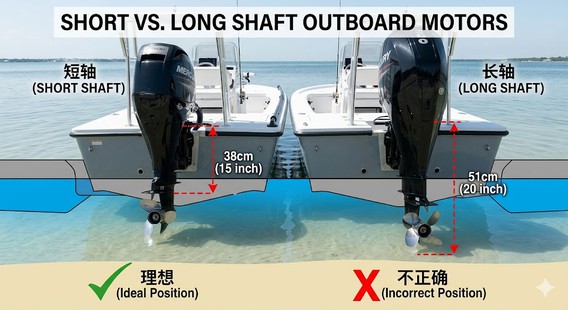
Short Tail Outboard Motors Vs. Long Tail Outboard Motors
Outboard motors are generally categorized into three types:
• Short Tail Outboard: Features a tail length of approximately 38CM.
• Long Tail Outboard: Features a tail length of approximately 50CM.
• Extra Long-Tail Outboard: Features a tail length of approximately 63CM.
It is actually quite simple to understand: the distinction between short-tail, long-tail, and extra-long-tail outboards lies solely in the varying lengths of this drive shaft. The longer versions are referred to as "long shaft" (or long tail), while the shorter versions are called "short shaft" (or short tail). This differentiation is necessary because the transom height-the height of the stern-varies from one boat to another.
Short Tail Outboard Engine-Compact And Responsive
Due to their shorter drive shafts, short-tail outboard engines are ideally suited for boats with relatively low transoms-such as aluminum boats, fishing skiffs, lightweight inflatable dinghies, and similar vessels. Since the sterns of these boats sit low in the water, a shorter drive shaft is more appropriate, ensuring that the propeller is positioned at the optimal depth. Short leg outboards feature a more compact structural design and are generally lighter in weight. Furthermore, because of the shorter drive shaft, power transmission is more direct, resulting in quicker acceleration and more responsive handling. Consequently, short-tail boat motors are a popular choice among many fishing enthusiasts and professionals working in near-shore environments.
However, it is important to inform every boat owner that short-tail boat engines do have their limitations; they are not suitable for navigation in waters characterized by heavy winds and rough waves. In choppy or turbulent seas, the boat's stern will pitch up and down significantly; this movement can cause the propeller to momentarily break the water's surface-resulting in "cavitation" (or free-spinning)-which ultimately leads to unstable navigation.
Long Tail Outboard Motors-Stability in Rougher Waters
Long tail outboard motors feature a longer drive shaft, allowing the propeller to sit deeper within the water. Compared to short tail outboards, long-shaft models are better suited for waters with significant wave activity; they offer superior navigational stability and prevent the propeller from "ventilating" (spinning in air). Long leg outboards are ideal for vessels with higher transoms-such as fiberglass fishing boats, cruisers, or certain offshore fishing vessels. This long-shaft design ensures that thrust is transmitted more evenly to the hull, maintaining better balance even during high-speed operation.
However, long-shaft outboards are heavier than their short-shaft counterparts; consequently, they place greater structural demands on the vessel and require a higher mounting position. A word of caution: a long leg marine motor must be installed on a vessel of appropriate dimensions; an improper match can actually produce counterproductive results.
Why Is Proper Matching So Important?
It is essential to select an outboard motor with the correct shaft length based on your boat's transom height. Generally speaking, smaller boats are paired with short-shaft outboards. Vessels with a transom height exceeding 50 cm are best suited for long-shaft outboards. Consider the analogy of wearing shoes: if your shoes are too large or too small, your feet will be uncomfortable, and your ability to walk will be impaired. By the same token, a shaft that is either too long or too short is inappropriate. If the shaft is too short, the propeller may ventilate; if it is too long, it will increase hydrodynamic drag and compromise handling. The outboard motor can only deliver its optimal performance when the shaft length is properly matched to the vessel's hull structure. Therefore, measuring your boat's transom height is a necessary and crucial step before making a purchase.
KLS Company is an outboard motor supplier with 20+ years of industry experience. We recommend that, ideally, the outboard's anti-cavitation plate should be positioned level with the bottom of the hull, or situated between 1 cm and 2.5 cm below the hull's bottom line. This specific positioning-as described above-represents the "sweet spot" that strikes the perfect balance between speed, cooling efficiency, and fuel economy.
Quick Tips For Choosing The Right Shaft Length
• If you are the owner of a new boat and are looking to purchase a boat engine, follow the advice outlined above: first, measure your boat's transom height, and then select a boat motor with the corresponding shaft length.
• If you own a used boat, do not simply purchase a replacement based on the original model specifications. It is essential to first measure your boat's current transom height; some previous owners may have raised the transom to enhance structural strength-something you must be sure to check.
• Let me also tell you about a clever little modification accessory you might not know about: the transom jack plate. A jack plate allows you to raise the engine, effectively compensating for any discrepancies in shaft length.
• If your boat is compatible with both shaft lengths, prioritize choosing a long-shaft outboard motor. In the second-hand market, long-shaft outboards typically appeal to a broader range of buyers than their short-shaft counterparts.
Selecting the right shaft length is all about striking the perfect balance between power output and hydrodynamic drag. A short-tail outboard signifies agility and explosive power, while a long-tail outboard represents stability and deeper immersion. Accurate measurement of your transom height is half the battle won. To learn more about Yamaha Enduro Outboard 15 HP, please contact KLS Supplier:
• +8615094051894
• Room 1705, Yihe Blue Diamond, No. 154, West Section of Second Ring South Road, Yanta District, Xi'an City
References
Wikipedia Outboard Motor
Does My Boat Need A Long Shaft Outboard Motor Or Short Shaft Outboard Motor?