

If you are the owner of a boat equipped with a new Two Stroke Outboard Motor, you will surely notice a button near the control console, which has wave-shaped arrows or up-down triangular symbols. That button is the trim switch. At this point, some boat owners might say, "I know that the trim switch is used to lift the propeller out of the water to facilitate docking."
It's not just that simple. In fact, trim is the most underestimated performance regulator on a ship. If it's adjusted correctly, the ship will start moving faster, consume less fuel, and be more stable to control; if it's adjusted wrongly, the bow will rise into the air, the stern will drag water, and even experience uncontrollable skidding like a water-skating accident.
What Is Trim?
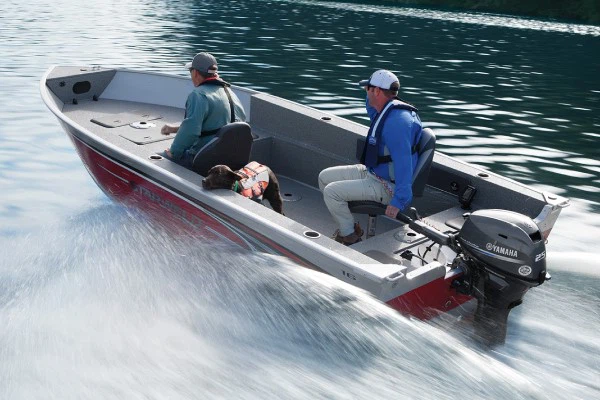
Trim of outboard motor is like the pitch of a ship. If the trim is negative, meaning it is too low, the bow of the ship will sink too deeply into the water. At this point, the resistance is too high, just like driving in mud-it not only consumes a lot of fuel but also cannot move fast. If the trim is positive, meaning it is too high, the bow of the ship will rise too high, causing the propeller to be too close to the water surface, creating air bubbles and causing the stern to splash water. Even the ship may suddenly veer off course. Either too high or too low is not ideal. The most ideal state is that after the ship starts to move, only about 1/3 to 1/4 of the bottom of the hull contacts the water, the bow is slightly raised, and the water splashes from about 5-10 meters behind the propeller. This state is called the trim balance point.
How Serious Could The Consequences Of Not Adjusting The Trim Be?
1. If The Trim Is Not Lowered At The Start, The Boat Will Never Be Able To Get Moving:
Many novice captains start with the bow raised high in the air, thinking it's due to insufficient power. But they are wrong. In fact, it's because the trim angle is too large, and the thrust direction of the propeller is too upward, causing the bow to be lifted up. If this happens, the trim should be fully retracted at the start, and then gradually adjusted upward when the boat starts moving.
2. When Sailing At High Speed, If The Trim Is Insufficient, The Boat Will Move Slowly And Consume More Fuel:
The bow sinks in the water, the hull sinks deeper, and fuel consumption increases by more than 30%. The top speed may be reduced by 5-10 km/h. This is a typical phenomenon where the waves in front of the bow are very high and the water splashes around the stern.
3. When In Wind And Waves, The Trim Does Not Move, Causing Severe:
When facing the wind, slightly retract the trim, that is, lower the bow a little, so that the boat cuts through the waves; when going with the wind, slightly raise the trim, that is, lift the bow a little, to prevent the bow from getting stuck in the front waves.
How To Correctly Adjust The Trim?
1. At The Start, Set The Trim To Zero And Fully Downward:
For all outboard engines during the starting phase, the propeller thrust direction should be as far backward as possible in a horizontal position. Procedure: Press the "downward" trim button for a long time until the instrument shows or hears the hydraulic stop.
2. Observe The Take-off Point:
When the ship speed gradually increases and the bow starts to change from pointing upwards to being level, that moment is the take-off point. Immediately start to slowly increase the trim upward, press it for 0.5-1 second each time, with an interval of 2-3 seconds.
3. Find The Water Splash Separation Point:
Here is a most practical judgment method for you. That is, look back at the water splashes on both sides of the stern. If the water splashes are close to the stern, it means the trim is insufficient. Continue to increase the trim upward. If the water splashes are 5-10 meters away from the stern and the ship is stable, this is the best trim at this time. If the propeller starts to blow air, the rotational speed suddenly increases or the stern sways laterally, it means the trim is too high. Immediately decrease the trim.
4. Fine-Tune According To The Operating Conditions:
| Working Condition Trim Suggestion | Trim Suggestion |
| Overload / Multiplayer / Big Wave | Downward |
| Light Load / Calm Water / Cruising | Upward |
| Sharp Bend | Pre-Cut A Little Trim |
| Counter-Current / Against The Wind | Slightly Trim |
Common Misconceptions
Trim ≠ Tilt. Many boat owners fail to distinguish between trim and tilt. Let me explain this to you in detail: Trim refers to small-angle adjustment, usually within 15-20 degrees, and is used during navigation. Tilt refers to raising the propeller significantly so that it completely emerges from the water. It is used when the boat is at anchor, in shallow water, or during towing. Remember, never use tilt at high speeds. Doing so can cause the propeller to instantly stall and the stern to swing sideways, which is extremely dangerous.
1. For small horsepower engines (15-30 horsepower), the trim changes are sensitive, and each fine adjustment has a smaller range.
2. For medium horsepower engines (40-90 horsepower), the priority is to use the water separation point as the judgment criterion.
3. For large horsepower engines (above 150 horsepower), it is recommended to install an electric hydraulic trim, which can achieve precise 1% stepless adjustment.
Also, aluminum boats are more sensitive to trim than fiberglass boats because the hull is lighter and the center of gravity is higher. Therefore, the adjustment range must be more gentle.
Conclusion
Adjusting the trim is essentially the art of balancing speed, fuel consumption, comfort, and safety. Before going out to sea, you must try the sequence: starting → take-off → high speed → turning → deceleration → parking. Feel the changes in the boat's movement each time you press a button. Remember the mnemonic: Start fully downward, take-off slowly lift; The farther the water splashes, the more fuel-efficient it is. When breaking the waves, come back quickly. For more details about Yamaha 40 HP Two Stroke Outboard, please contact KLS Company:
• +8615094051894
• Room 1705, Yihe Blue Diamond, No. 154, West Section of Second Ring South Road, Yanta District, Xi'an City
FAQ
Q1: My outboard motor doesn't have a trim angle indicator. What should I do?
A1: The vast majority of small and medium horsepower outboard motors do not have digital displays. We can determine the trim angle by observing the boat's posture, the point where water splashes separate, the sound of the propeller, and the changes in the rotational speed indicator. It is recommended to practice at a low speed in calm waters first, and feel the corresponding boat response each time you press the trim switch.
Q2: When sailing at high speed, you suddenly feel the stern of the boat "swinging". What's the reason?
A2: The typical case is that the trim is too high, causing part of the propeller to stick out of the water and suck in air (commonly known as cavitation). The correct approach: Immediately release the throttle and simultaneously press the trim downward button. Wait until the boat stabilizes before restarting the engine. Do not continue to add fuel while the boat is in the swaying state.
Q3: How are the trim adjustments of two-stroke and four-stroke outboard engines different?
A3: Two-stroke engines (such as a 60-horsepower two-stroke) have earlier torque output and higher power density, and are more sensitive to trim changes; four-stroke engines have a more linear power output and a slightly larger trim tolerance. However, the fundamental principle remains the same: full down at startup and upward adjustment after acceleration.
Q4: How should the trim be adjusted on a windy and stormy day?
A4: With the wave: Appropriately lower the trim to allow the bow of the boat to enter the wave, reducing the impact sensation.
With the current of the wave, appropriately raise the trim to prevent the bow from getting stuck in the trough of the previous wave.
With the side wave: Maintain a moderate trim, prioritizing stability. Appropriately reduce the speed.
Q5: I often tow the boat. Is there any special operation required for trimming?
A5: Yes. Before towing, the outboard motor must be fully tilted up and secured with a mechanical locking clip. If not lifted, the bumpy road surface will severely damage the trim cylinder, transmission shaft and stern plate. Also, never reverse the boat without fully retracting the trim; otherwise, the propeller is very likely to hit underwater objects.
References
Wikipedia Outboard Motor